
In vitro Evaluation of Thrombolytic Activity and Flavonoid Profiling of Borassus flabellifer L. Using Streptokinase as Standard on Chicken Blood Clots
N. Satheeshkumar
*

Department of Pharmacology, SSM College of Pharmacy, Jambai, Bhavani, Erode – 638312, Tamil Nadu, India and The Tamil Nadu Dr. M.G.R. Medical University, Chennai – 600032, India.
V.S. Bharathraj
Department of Pharmacology, SSM College of Pharmacy, Jambai, Bhavani, Erode – 638312, Tamil Nadu, India and The Tamil Nadu Dr. M.G.R. Medical University, Chennai – 600032, India.
A. Deenadhayalan
Department of Pharmacology, SSM College of Pharmacy, Jambai, Bhavani, Erode – 638312, Tamil Nadu, India and The Tamil Nadu Dr. M.G.R. Medical University, Chennai – 600032, India.
R. Deepika
Department of Pharmacology, SSM College of Pharmacy, Jambai, Bhavani, Erode – 638312, Tamil Nadu, India and The Tamil Nadu Dr. M.G.R. Medical University, Chennai – 600032, India.
P. Dhanush Kumar
Department of Pharmacology, SSM College of Pharmacy, Jambai, Bhavani, Erode – 638312, Tamil Nadu, India and The Tamil Nadu Dr. M.G.R. Medical University, Chennai – 600032, India.
S. Kannan
Department of Pharmacology, SSM College of Pharmacy, Jambai, Bhavani, Erode – 638312, Tamil Nadu, India and The Tamil Nadu Dr. M.G.R. Medical University, Chennai – 600032, India.
B. Sangameswaran
Department of Pharmacology, SSM College of Pharmacy, Jambai, Bhavani, Erode – 638312, Tamil Nadu, India and The Tamil Nadu Dr. M.G.R. Medical University, Chennai – 600032, India.
*Author to whom correspondence should be addressed.
Abstract
Background: Thrombotic disorders, characterized by fibrin-rich clot formation within blood vessels, are a leading cause of global morbidity and mortality worldwide (World Health Organization, 2023). Thrombolytic agents such as streptokinase act by converting plasminogen into plasmin, thereby degrading fibrin clots; however, their use is limited by adverse effects, high cost, and lack of fibrin specificity (GraphPad Software Inc., 2023, Rahman et al., 2022). These limitations have prompted the search for safer and cost-effective alternatives, particularly from plant-derived bioactive compounds such as flavonoids, which possess significant cardioprotective and antithrombotic activities (Collen and Lijnen, 2021).
Objective: The study aims to evaluate the in vitro thrombolytic activity of Borassus flabellifer L. seed coat extract and to quantify its flavonoid content.
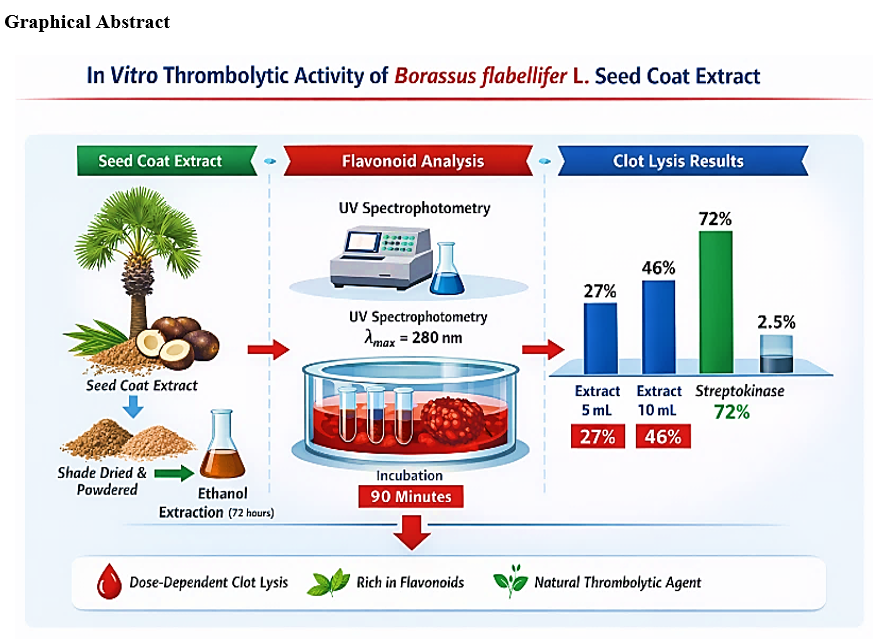
Methods: The seed coat extract was prepared using ethanol by cold maceration and subjected to qualitative phytochemical screening. Total flavonoid content was determined using UV spectrophotometry at 280 nm based on established methods. Thrombolytic activity was assessed using a gravimetric clot lysis method with chicken blood clots (Barreto, 2020). Streptokinase was used as the positive control, while distilled water served as the negative control
Results: The extract exhibited a high flavonoid content with an absorbance of 4.000 at 280 nm, indicating the presence of significant polyphenolic compounds. It demonstrated dose-dependent thrombolytic activity, producing 27% clot lysis at a lower concentration and 46% at a higher concentration, compared to 72% clot lysis by streptokinase and 2.5% by distilled water (Barreto, 2020).
Conclusion: The ethanolic seed coat extract of Borassus flabellifer L. exhibited significant in vitro thrombolytic activity, which may be attributed to its high flavonoid content. These findings suggest its potential as a promising candidate for the development of plant-based thrombolytic agents; however, further studies are required to isolate active constituents and evaluate in vivo efficacy.
Keywords: Borassus flabellifer L., palmyra palm, thrombolytic activity, flavonoids, streptokinase, clot lysis, in vitro, phytochemicals